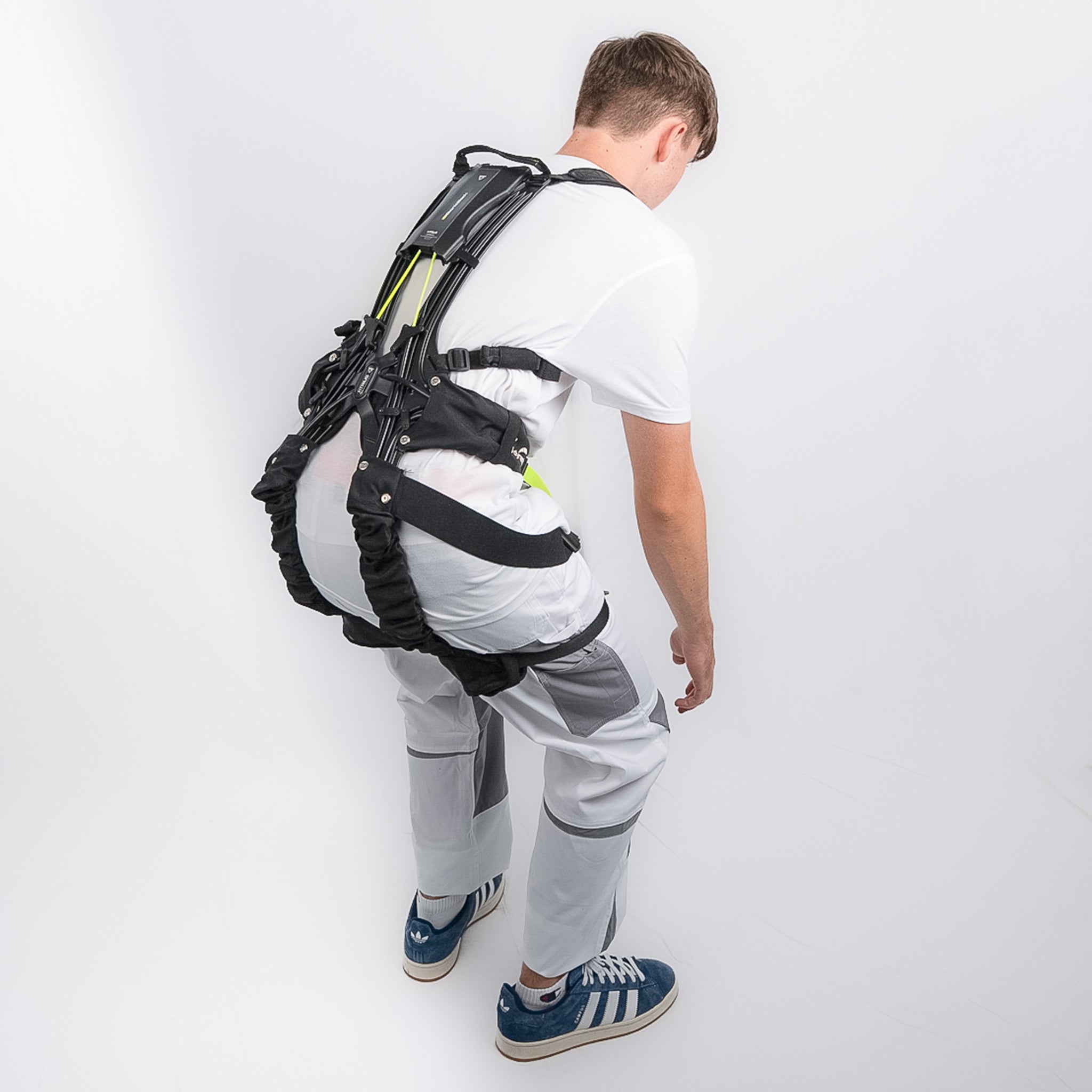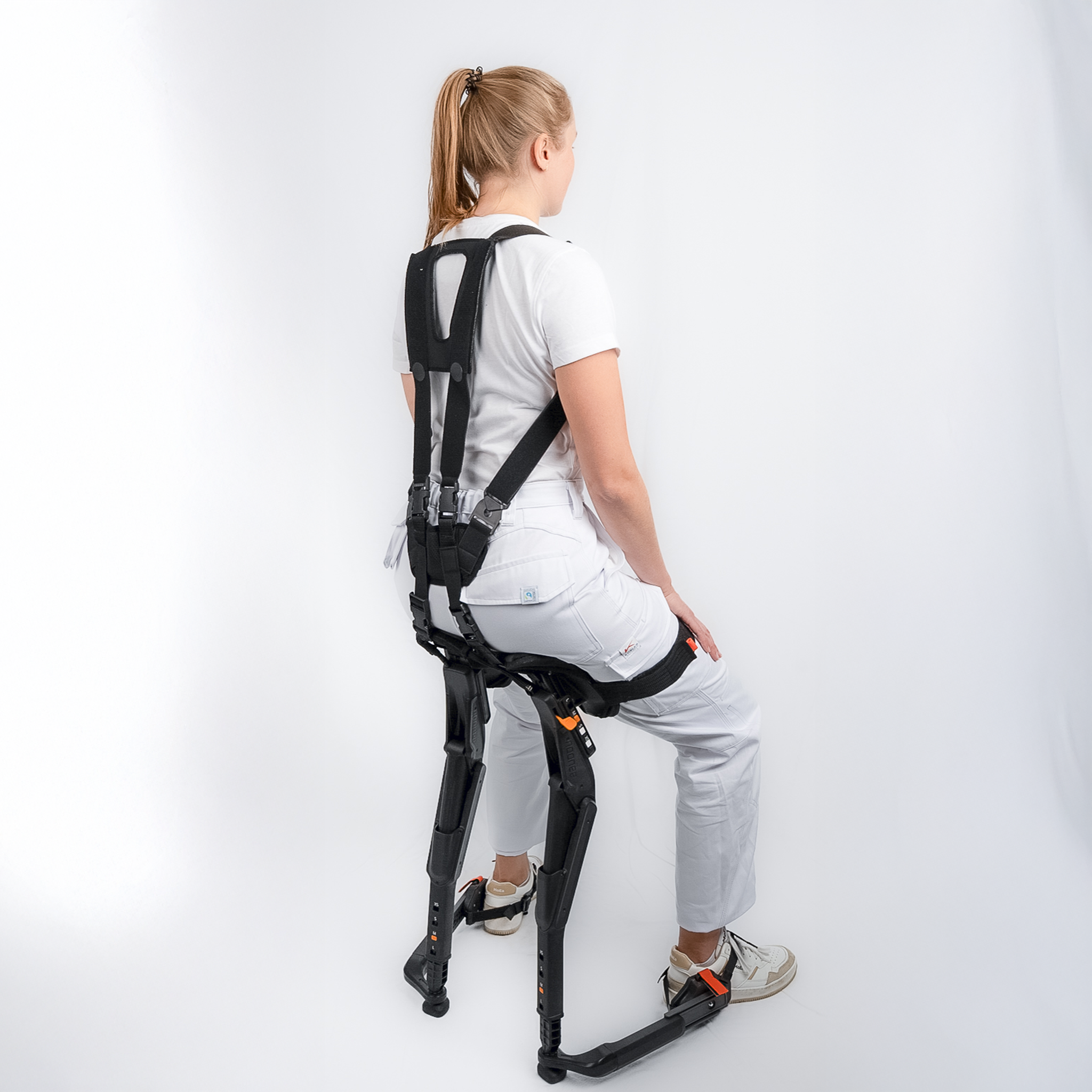
Performance declines significantly during load cycles
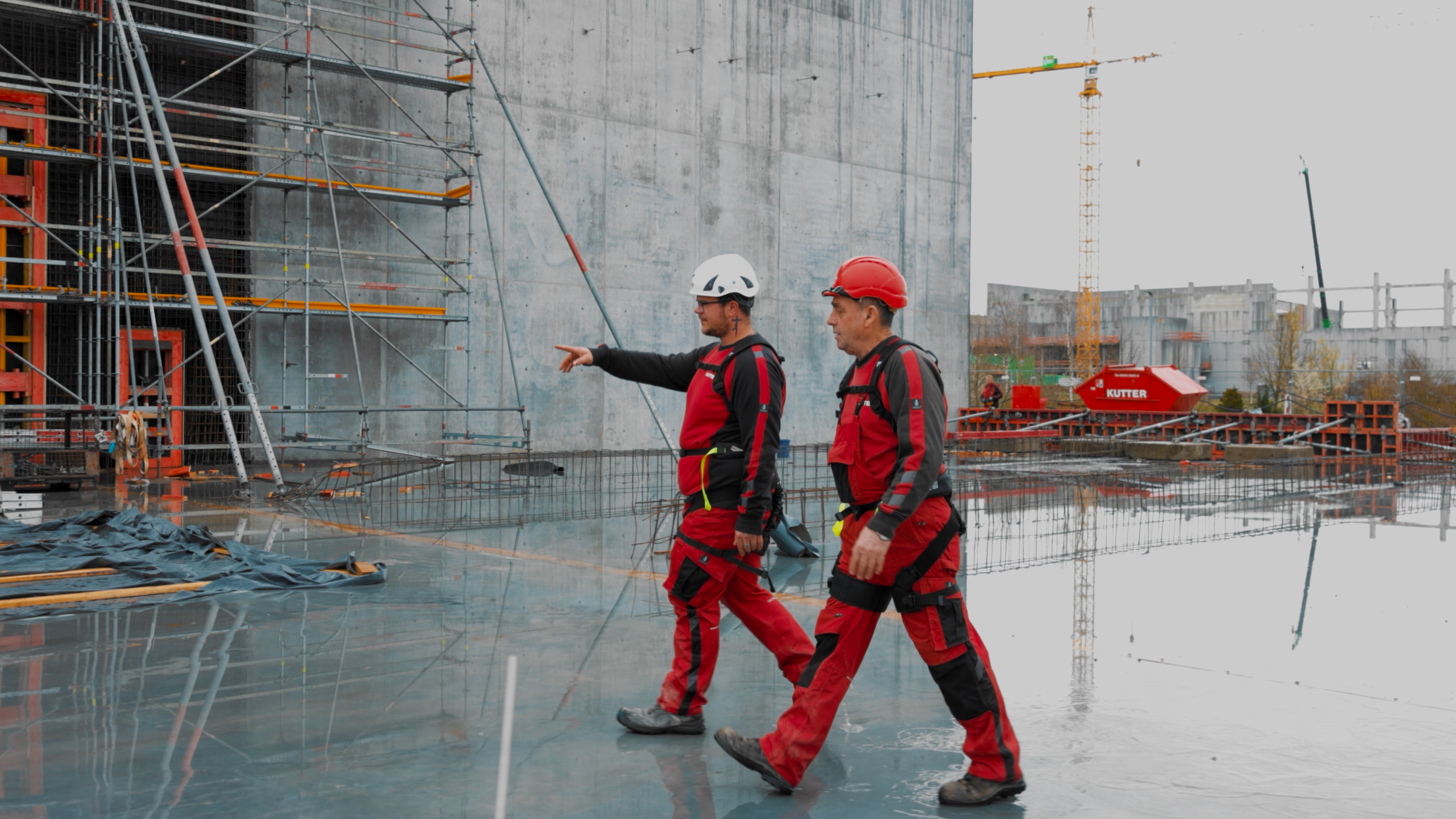
In many fields of work, physically demanding tasks are part of daily life. Lifting, carrying, overhead work, or working in awkward postures often cannot be avoided. What seems natural in daily business leads to measurable consequences in the long run: increasing fatigue, growing strain, and an elevated risk of accidents and absences.
When repetitive lifting and force movements are performed under submaximal load, a typical load dynamic emerges: With increasing repetitions, performance significantly decreases, while movements slow down and subjective exertion continuously rises. What matters is not the individual movement, but the cumulative load over time.
Exoskeletons provide support where physical work becomes a continuous strain, and they stabilize performance throughout the entire workday.
When Exoskeletons Make Sense in Everyday Work
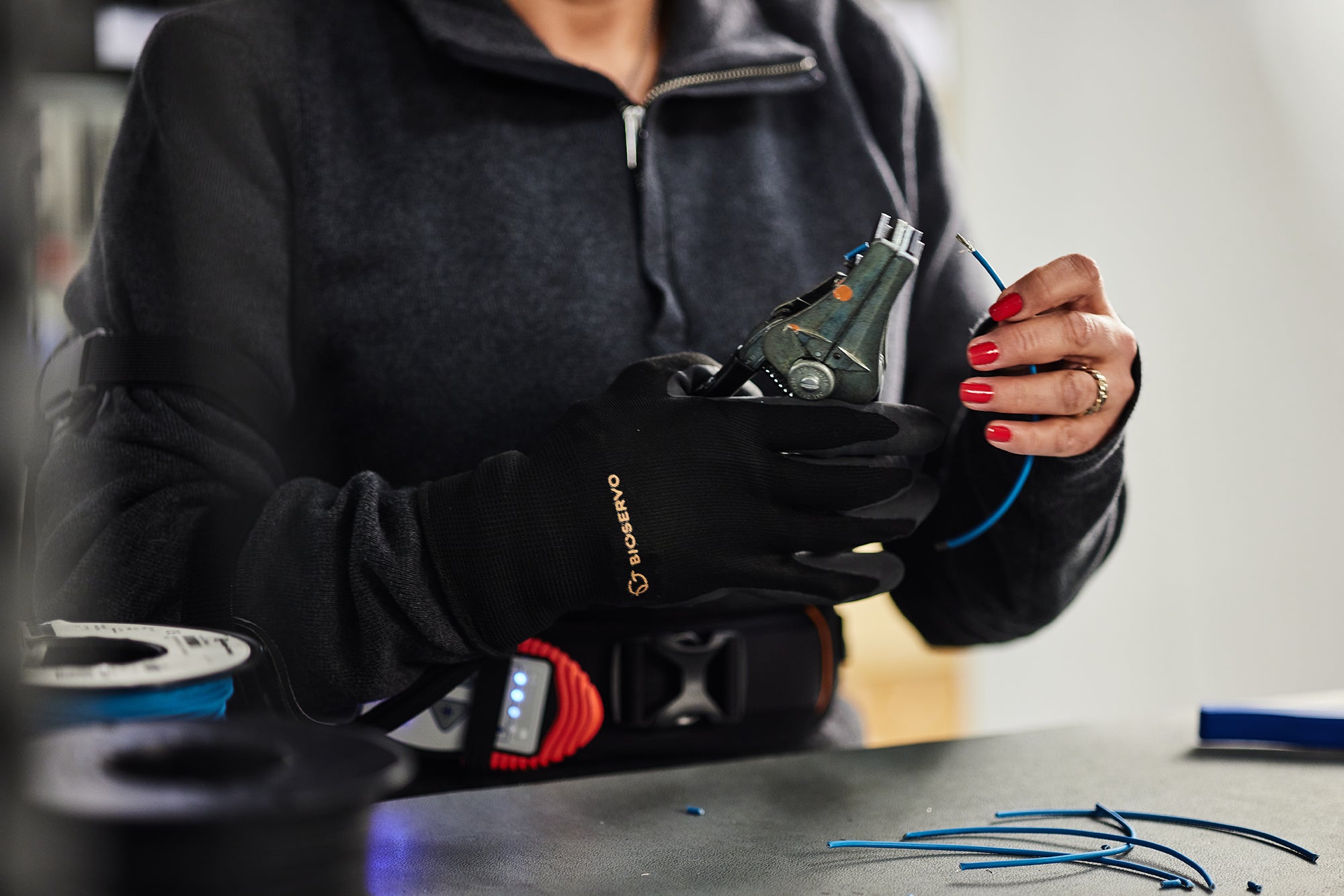
Exoskeletons are particularly relevant when physical strain is not sporadic but occurs permanently or recurrently.
Typical application scenarios include:
- recurrent movements with high physical strain
- static holding work over extended periods
- overhead and lifting work
- activities in ergonomically unfavorable positions
- processes with increasing fatigue over the course of the day
In these situations, strain accumulates continuously – often unnoticed, but with a clear impact on performance and safety.
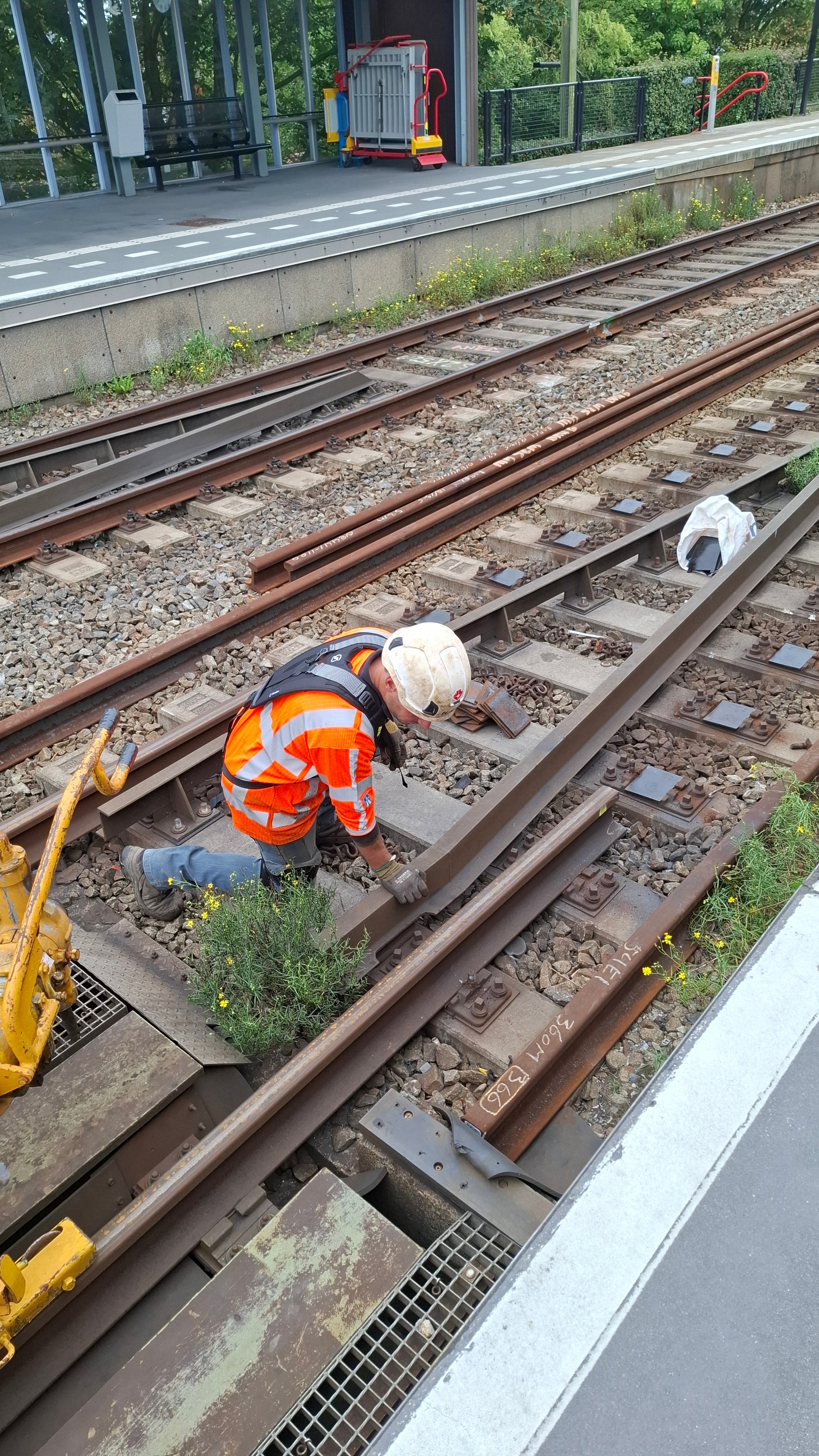
Targeted support – exactly where it's needed
Fatigue occurs gradually. With each repetition, muscular effort increases, while at the same time the ability to use force efficiently decreases.
Depending on the exoskeleton, a varying part of the load can be mechanically taken over, meaning the body works in a lower stress range and the typical drop in performance is slowed down.
In everyday work, this leads to:
- less muscular fatigue during repetitive tasks
- more stable execution of movements even under continuous strain
- more consistent performance throughout the day
For people, this means: Work remains controllable and precisely executable even at the end of a shift.
Reducing burdens before they become a problem
In addition to short-term performance stabilization, long-term physical strain is particularly crucial, as musculoskeletal disorders usually arise from the sum of many repeated strains.
For objective assessment, ergonomic calculation models based on biomechanical approaches are used. These models quantify, for example, the strain on the lower back based on load weight, lever arm, posture, and frequency of repetition. Key assessment parameters are the resulting joint moments and forces in the lumbar spine area, which accumulate over the workday.
The graphic shown exemplifies the result of such a model calculation. By using an exoskeleton, part of the resulting load moment is absorbed, which reduces the effective strain on the lumbar spine per movement.
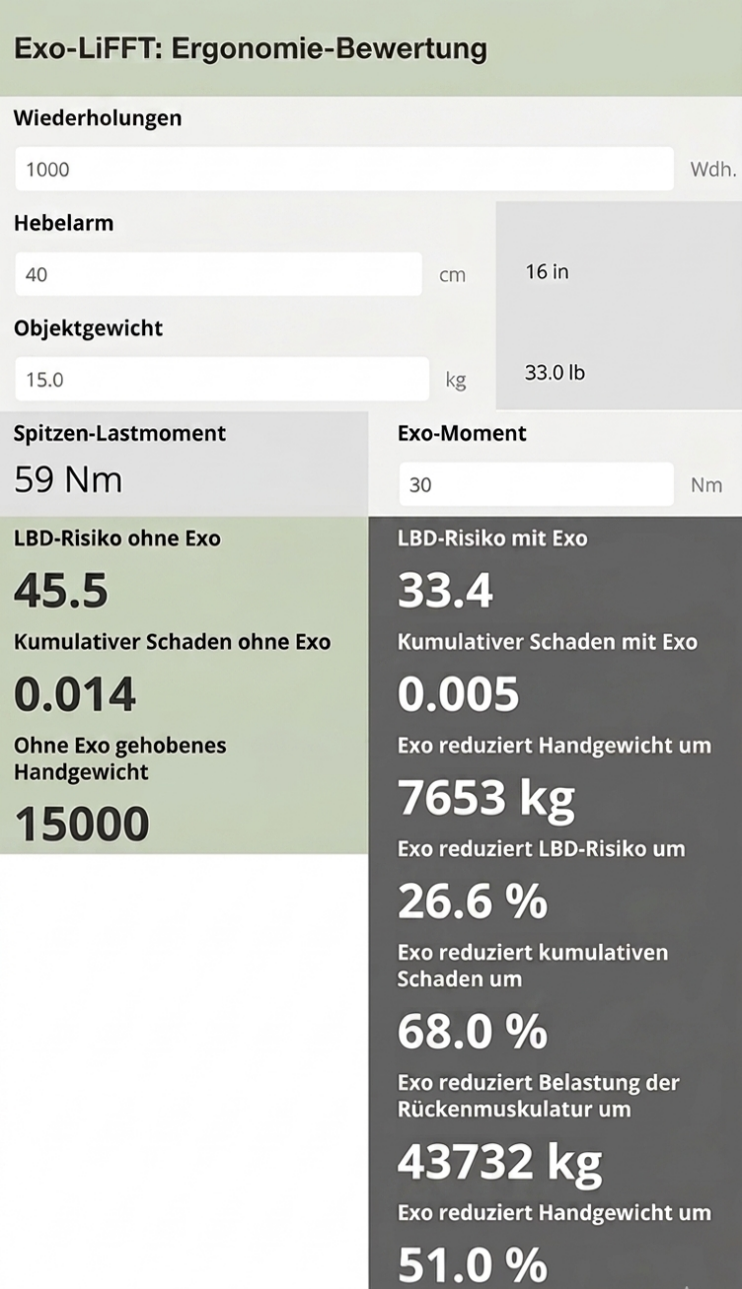
Exoskeletons reduce the mechanical load per movement, decrease peak loads, and thereby measurably lower the overall load over the workday.
The calculation shown illustrates this with a concrete example: If a load of 15 kg with a lever arm of 40 cm is moved about 1,000 times a day, a load moment of 59 Nm is generated in the lumbar spine area. Without support, this repeated stress leads to high biomechanical strain on the lower back.
The exoskeleton used generates a supportive counter-moment of 30 Nm. This reduces the mechanical load that acts on the lumbar spine and back muscles with each individual lifting movement.
The model calculation shows several measurable effects:
- Reduction of LBD risk ("Low Back Disorder Risk") from 45.5 to 33.4
- Reduction of cumulative load by about 68%
- Relief of back muscles by over 43,000 kg total muscle load
- Reduction of the effective hand load by about 51%
The calculation thus demonstrates how significantly repeated lifting movements biomechanically accumulate – and how exoskeletons can specifically reduce this load. The result is a
comprehensible relief of the lumbar spine and reduced long-term strain on the musculoskeletal system.
More stable processes through reduced fatigue
Physical fatigue directly affects process quality and safety. As strength decreases, the susceptibility to errors, movement variability, and uncertainty in execution increase.
The use of exoskeletons ensures:
- fewer performance fluctuations throughout the day
- lower error rates in
physically repetitive tasks - more stable work quality despite
physical demands
Thus, exoskeletons support stable and reproducible work processes – particularly in tasks with high physical repetition.
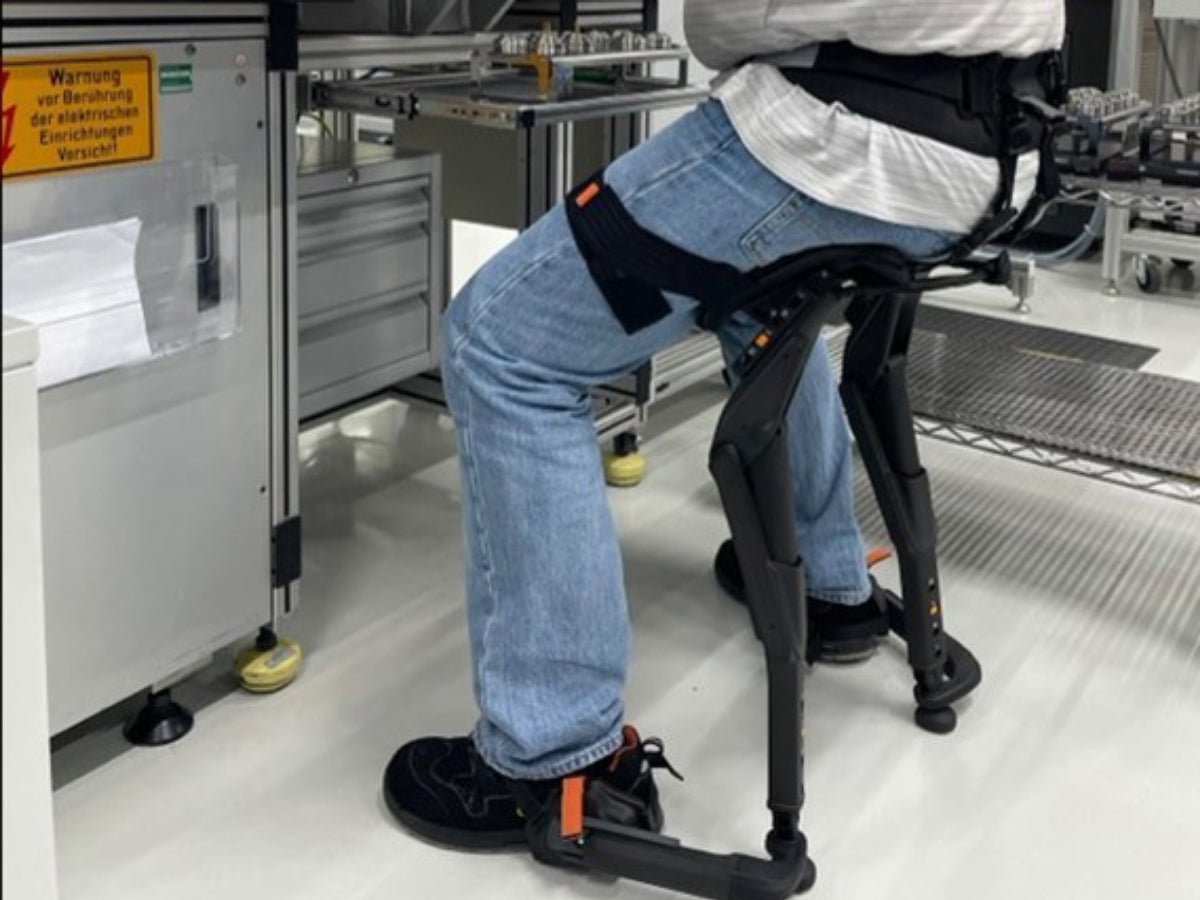
Relief that remains noticeable in everyday work
Exoskeletons act directly on the musculoskeletal system and reduce the mechanical stress that affects muscles, tendons, and joints with every single movement. This particularly relieves the musculoskeletal system, especially in highly stressed areas such as the lumbar spine, shoulders, and neck.
This cushions peak loads and reduces repetitive stress on individual body structures. Physical strain is distributed more evenly, leading to slower fatigue and fewer compensatory poor postures.
In the long term, this can help prevent signs of overuse, support recovery between periods of strain, and maintain more stable physical resilience.
The result is not a change in the activity itself, but a more sustainable physical stress situation that relieves the body in the long term. In short, you stay fit for work longer and, most importantly, healthy.
Conclusion: When exoskeletons are worthwhile
Exoskeletons are beneficial wherever physical labor is an integral part of the work process and fatigue systematically builds up throughout the day.
They do not replace human strength but change its course: fatigue sets in later, stress is distributed more evenly, and performance remains stable for longer.
What is crucial is not the individual movement, but its repetition over time. This is precisely where exoskeletons come in, reducing physical strain by distributing the load more evenly.